- Two-Page paper
- Tool: Microsoft Co-Pilot
The paper: I chose to prompt Co-pilot with a history paper about Napoleon Bonaparte. My prompt initially was “Write a two-page history paper on Napoleon Bonaparte, providing a well-rounded exploration of his role in history and what people need to know about him.” This initial paper was broken up by large section headings and not structured as an academic paper you would turn in for class, so before analyzing the content, I prompted Co-Pilot with “format this paper into a traditional college paper, as opposed to sectioned thoughts.”
From a general standpoint, the content of the paper is well written and has enough of a voice that it’s passable as a paper. The flow is matter-of-fact and lacks individuality. While it’s passable, it certainly wouldn’t be appropriate for an actual class. The dialogue that you, as an individual, start with the courses you take shapes your work and your thoughts. It is important that when you write about a subject, you place yourself into the piece. The paper in its current iteration would need a lot of shaping and to be fed content written by the student, as well as a plethora of prompts to further the piece. The sources that Co-Pilot used in this paper were Britannica, WorldHistory.Org, History Channel, and Historyskills.com. Currently, the AI model is pulling from sources that compile their own list of sources, but it isn’t pulling individual academic works. The paper started with some general origin information about Napoleon and moved into his military service and claim to fame. From there, the paper talked about his influencd, and military victories, his time as the emperor of France, his two exiles, and his lasting legacy.
2. The art piece
tool: Co-Pilot
My prompt was “create a landscape painting of Napoleon Bonaparte in the style of classical European painters of the time.”
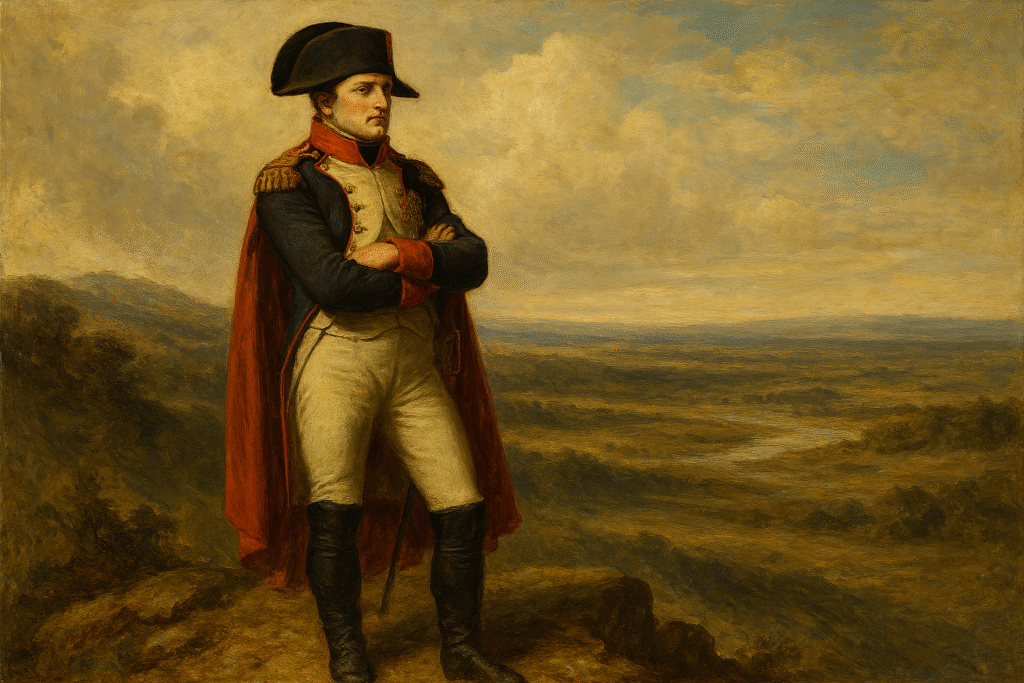
AI Image of Napoleon in a landscape
This image generation tool, similar to the writing tool, requires much input and prompt writing from the user. The AI prompted me to provide further changes I wanted to add to the art piece. In this image, it is difficult to directly state what looks artificially generated about this, but it is mistakenly a product of AI. Napoleon himself sticks out as a culmination of art style and deviates from the uninspiring backdrop. upon zoming in, some of the details become blurred and messy. The red piping on his coat, for example, loses its shape and stops prematurely.
Conclusion of the image and paper:
In its current itteration I see an AI tool like Co-Pilot as an effective brainstorming space, that thrives off of heavy input from the user. As a tool for generating work, it is ineffective and unethical in Academia use. I fear that the use of it without education on the tool will create an environment where students lack facets of literacy and critical thinking. The use of AI-generated art is very aggressive and currently seems more harmful in some ways than text generation. While the Napoleon piece is simple and trivial, there are many sources of AI generated i,agry and video that mislead the populace, and are even propagandized. Now that AI has been democratized in some sense, it is crucial to set boundaries and utilise education.
Manuscript Translation:
I used Gemini to transcribe a page from the National Frederickbsirg Cemetery ledger, which listed soldiers’ deaths. In this instance, the handwriting was well done and clear. Even so, I was impressed with Gemini’s organisation, exploration, and further inquiry into the provided content. The prompt was “This document is from a Cemetery ledger. It was written in the 19th century and lists names. Help me transcribe what the text says.” Gemini provided data about the Ledger that I did not input. The transcription itself was presented with the same columns and rows as the original text. The writing matched up with the ledger. Gemimi also explained certain symbols or words present in the ledger and gave them a historical context. Gemini then provided the opportunity for further inquiry about the ledger. As stated earlier, this use of AI for transcription is the path that I see Ai excewlling at. This is a computational tool that can accommodate your work and aid in research. In the study of History, AI has many opportunities to become an effective tool.